

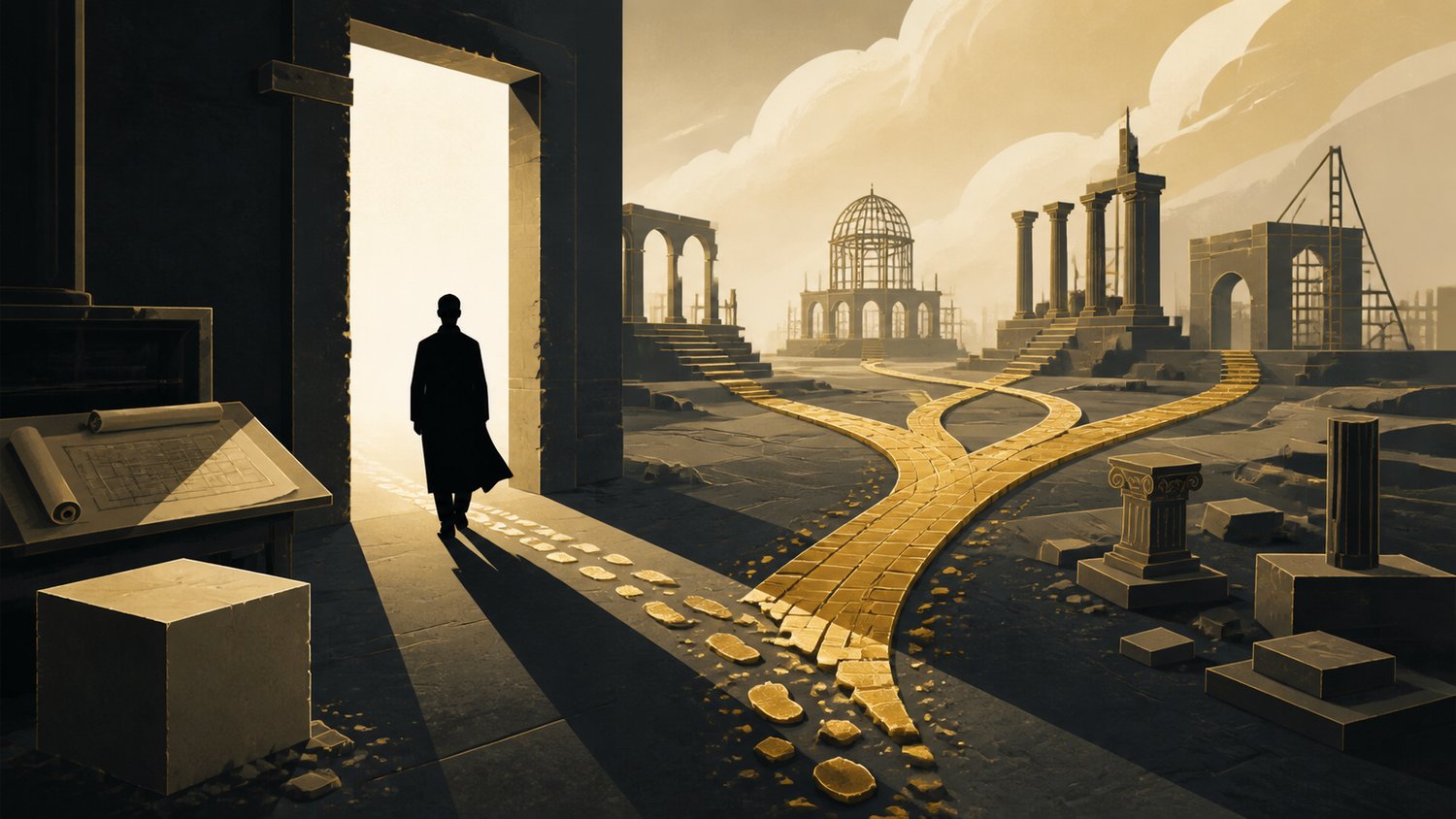
“Existence precedes essence” means that human beings are not born with a fixed purpose or completed identity. In Jean-Paul Sartre’s atheistic existentialism, a person first exists, encounters a particular situation, and then becomes who he or she is through choices and actions. The slogan does not mean that bodies, histories, or circumstances are unreal. It means that none of them supplies a final script that determines what a person must become.
That is the concise answer. Its importance becomes clearer when we distinguish Sartre’s claim from several popular versions of it.
Essence and existence in ordinary objects
An essence answers the question “What is this?” It can include an object’s defining structure, function, or purpose. With a manufactured object, the plan normally comes first. A craftsperson conceives a knife for cutting and then makes an object that fulfills that design. Its essence, in this limited sense, precedes its existence.
Sartre uses this contrast in Existentialism Is a Humanism. If a Creator designed humanity, then human beings might likewise possess a nature and purpose conceived before any individual appeared. Sartre begins instead from atheism. With no divine maker, he argues, there is no prior human blueprint. A person appears first and defines himself afterward.
The Yale University Press description of Sartre’s lecture (https://yalebooks.yale.edu/book/9780300242539/existentialism-is-a-humanism/) summarizes the point: choice creates the self or essence that was not present as a completed plan at birth.
What Sartre means by “existence”
Existence here is not mere biological survival. It is concrete human life: being in a body, in a society, with a past one did not choose and possibilities not yet realized. A human being finds himself already present before he possesses a settled definition of who he is.
Sartre describes consciousness as “for-itself,” distinct from the solid being of things “in-themselves.” Consciousness can take a distance from its present condition. A person can say, “I am this now, but I need not remain this.” That gap between fact and possibility makes self-transformation possible.
The Stanford Encyclopedia of Philosophy’s entry on Sartre (https://plato.stanford.edu/entries/sartre/) places the slogan within this broader account of consciousness, freedom, anguish, and responsibility. The phrase is not motivational decoration. It condenses a theory of what human existence is.
What Sartre means by “essence”
Sartre denies a pre-given essence, not every stable description. People acquire character, projects, loyalties, skills, and social identities. The point is that these do not arrive as an unalterable metaphysical specification.
For Sartre, action matters more than hidden potential. Identity takes form through lived commitments. The future remains open, but earlier acts become part of the factual situation from which the next choice is made.
This is why the slogan is both liberating and severe. It says that a label does not exhaust you. It also denies the comfort of treating good intentions as a substitute for conduct.
Does the slogan mean “you can be anything”?
No. Sartrean freedom is not magical power. A person does not choose his birthplace, early education, body, historical period, or every option available to him. Sartre calls such givens “facticity.” They shape the field in which choice occurs.
The relevant freedom is the capacity to take up a situation through a project: to interpret its meaning, pursue some possibilities, reject others, and answer for the response. The Stanford Encyclopedia’s overview of existentialism (https://plato.stanford.edu/entries/existentialism/) explains this tension through facticity and transcendence. Bad faith can arise from denying either side—pretending one is a fixed thing or pretending circumstances impose no real limits.
Later Sartre gave greater attention to social and historical constraints. A fair account therefore avoids the caricature that existentialism regards poverty, oppression, illness, or coercion as imaginary.
Why the idea leads to freedom
If no essence specifies what you must be, then no definition can complete your choosing in advance. You continually project yourself toward possibilities. Even accepting a social role is a way of taking it up rather than proof that the role mechanically determines you.
Freedom, on this account, is not an optional faculty that can be switched off. Refusing to decide still leaves a practical result and expresses a stance. Following a crowd is itself a way of choosing the crowd. Sartre therefore moves from existence before essence to his famous claim that human beings are “condemned to be free.”
The freedom is exhilarating because a past does not close every future. It is disturbing because excuses become harder to sustain.
Why the idea leads to responsibility
Self-creation sounds private, but Sartre gives it a public dimension. By choosing a way of life, a person presents that way as choice-worthy. In Existentialism Is a Humanism, he argues that choosing oneself also projects an image of humanity.
This does not mean everyone must imitate each act. It means action cannot be treated as morally weightless. Choice declares, through conduct, what one takes a human life to be worth doing. Anguish is the lucid awareness that no external rule can make the decision on one’s behalf.
The Internet Encyclopedia of Philosophy’s account of Sartrean existentialism (https://iep.utm.edu/sartre-ex/) explains how freedom, authenticity, and a universal dimension of choice are connected in this ethical project.
The strongest insight in the slogan
Sartre identifies a real danger in reducing people to categories. “Coward,” “failure,” “waiter,” “outsider,” or even “success” can become prisons when treated as complete substances. Human beings do exceed their current roles. They can repent, learn, repair, and begin differently.
The slogan also exposes evasive language. “That is simply who I am” may describe a durable habit, but it can also disguise the repeated choices that sustain it. Existentialism asks whether a supposed identity is being used to avoid responsibility.
This remains valuable even for readers who reject Sartre’s atheism. A given human nature and meaningful freedom need not be opposites.
The central philosophical difficulty
Sartre presents the absence of a Creator as the reason no human essence precedes existence. The conclusion therefore depends on more than an observation about choice. It depends on a metaphysical premise about God, design, and human nature.
A further question follows. If every human being is necessarily a free, self-defining “for-itself,” has Sartre identified a universal feature of human nature while denying that human nature exists? Defenders can answer that he rejects a fixed substantive blueprint, not the formal structures of consciousness. Critics reply that the formal structure is still a shared account of what humans are.
The dispute cannot be resolved by repeating the slogan. It requires asking what counts as an essence and whether nature must determine every act to be real.
Does existence before essence create meaning?
It explains how a person commits to projects and makes things matter within a life. It does not automatically establish that the resulting values are objectively binding. If meaning is wholly created by choice, why should one project be better than another? If authenticity is better than self-deception, what gives that judgment authority?
Sartre and later existentialists offer sophisticated answers based on freedom, situation, reciprocity, and the freedom of others. The Stanford Encyclopedia entry on authenticity (https://plato.stanford.edu/entries/authenticity/) notes both the appeal and the ethical difficulty: authenticity can specify how one chooses without fully determining what one ought to choose.
This is where the slogan changes from a description of self-making into a question about moral foundations.
Read Sartre with the lens on—and then test it
Freedom Without a Lord, Chaos Without a Ceiling, Book Four of Taking Off the Lens, enters Sartre’s system at full strength before examining whether freedom can ground its own value and responsibility. The interactive book is available from Veluna Press (https://store.velunapress.com/b/b1Gcn).
Frequently asked questions
Who first said “existence precedes essence”?
The formulation is most closely associated with Jean-Paul Sartre, especially his 1945 lecture later published as Existentialism Is a Humanism. Related ideas appear earlier in existential philosophy, but Sartre made the phrase a defining summary of atheistic existentialism.
Does existence precedes essence mean there is no human nature?
For Sartre, it denies a divinely designed or fixed essence that dictates an individual’s purpose before life is lived. He still describes common structures such as consciousness, facticity, transcendence, and freedom, which creates an important debate about how broadly “human nature” should be defined.
Is Sartre saying choices have no consequences?
The opposite. Choices form character, alter one’s situation, affect others, and become facts that later choices must confront. The future is open, but it is not detached from the past.
The clearest summary is this: existence precedes essence means that a human being is present before he has a completed definition, and his identity takes shape through situated choices. The principle protects the possibility of change, while placing a heavy burden of responsibility on the chooser.
Sources
Jean-Paul Sartre (https://plato.stanford.edu/entries/sartre/), Stanford Encyclopedia of Philosophy.
Existentialism (https://plato.stanford.edu/entries/existentialism/), Stanford Encyclopedia of Philosophy.
Authenticity (https://plato.stanford.edu/entries/authenticity/), Stanford Encyclopedia of Philosophy.
Jean-Paul Sartre: Existentialism (https://iep.utm.edu/sartre-ex/), Internet Encyclopedia of Philosophy.
Existentialism Is a Humanism (https://yalebooks.yale.edu/book/9780300242539/existentialism-is-a-humanism/), Yale University Press.