

When Stephen Hawking wrote that the universe can create itself because a law such as gravity exists, he was not describing a universe acting before it existed. He was arguing that quantum cosmology may allow a self-contained physical history that ne...
Read More
The laws of physics can describe how a universe behaves and, in some models, assign probabilities to cosmic states. Whether laws can literally create a universe from absolute nothing depends on what laws are. A mathematical description does not act,...
Read More
The Hartle–Hawking no-boundary proposal is a model for the quantum state of the universe in which the earliest geometry has no sharp classical boundary. Instead of treating time as extending back to a singular first edge, the proposal uses a path in...
Read More
The Big Bang theory shows that the observable universe evolved from an extremely hot, dense early state and has expanded for about 13.8 billion years. It does not by itself prove an absolute beginning from nothing. Classical relativity reaches a bou...
Read More
Fine-tuning in cosmology is the claim that life-permitting cosmic structure depends sensitively on the form of physical laws, the values of constants, or early conditions. Small changes in some parameters would prevent long-lived stars, complex chem...
Read More
“Existence precedes essence” means that human beings are not born with a fixed purpose or completed identity. In Jean-Paul Sartre’s atheistic existentialism, a person first exists, encounters a particular situation, and then becomes who he or she is...
Read More
Jean-Paul Sartre said human beings are “condemned to be free” because we do not choose to exist, yet once we exist we cannot escape choosing. No fixed human essence, divine command, instinct, emotion, or circumstance can make our decisions for us in...
Read More
Bad faith in Jean-Paul Sartre’s philosophy is self-deception about human freedom and situation. A person acts in bad faith when he presents himself as a fixed object with no choice, or as pure freedom with no past, body, role, or constraint. In both...
Read More
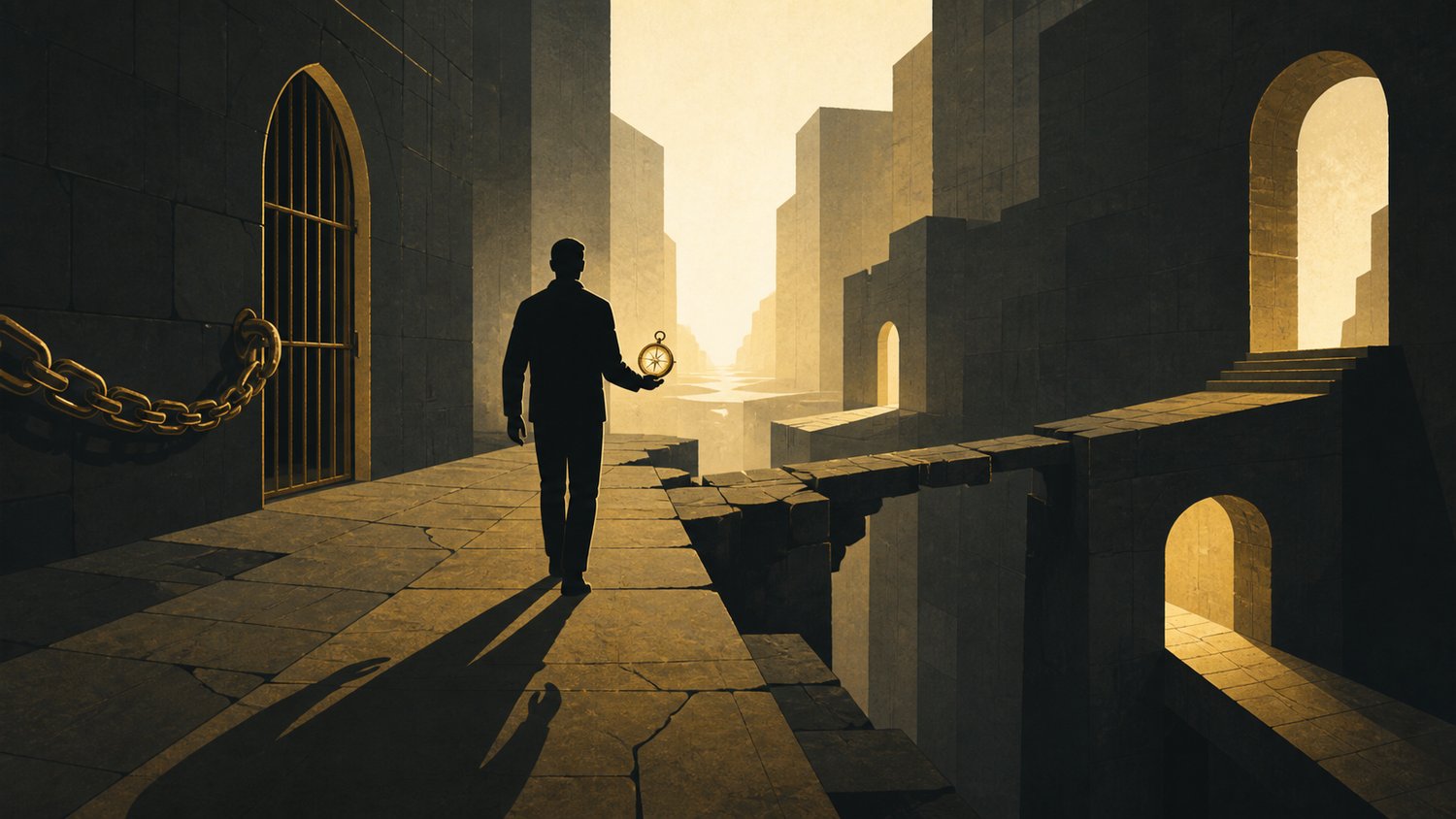
Sartre’s radical freedom does not simply ignore circumstance. His philosophy distinguishes freedom from facticity: people choose within bodies, histories, social structures, and situations they did not choose. However, his early account gives freedo...
Read More

Existentialism can explain moral agency without God: human beings choose, commit, take responsibility, and encounter other free persons in concrete situations. The harder question is whether Sartre’s atheistic existentialism can ground objective mor...
Read More

For Albert Camus, the absurd is the conflict between the human demand for meaning, order, and intelligibility and a world that gives no final answer. The absurd is not simply sadness, disorder, or a strange event. It arises in the relationship betwe...
Read More

Camus calls suicide the one serious philosophical problem because the first test of any worldview is whether it gives a person reason to continue living. Before debating knowledge, ethics, or metaphysics, one must face the practical question: if lif...
Read More

We must imagine Sisyphus happy, in Camus's philosophy, because lucid acceptance turns endless labor from an unexplained punishment into a consciously inhabited fate. Sisyphus cannot make the stone remain at the summit, but he can refuse false h...
Read More
For Camus, revolt is a lucid refusal of oppression, humiliation, and resignation that affirms a limit shared by human beings. Nihilism denies or dissolves value; revolt says that something in a person must not be violated. Camus's rebel says no...
Read More
Camus can explain how people experience meaning and why revolt generates solidarity, but grounding objective meaning and morality without God is harder. His philosophy praises lucidity, life, dignity, truth, freedom, and limits while describing the ...
Read More